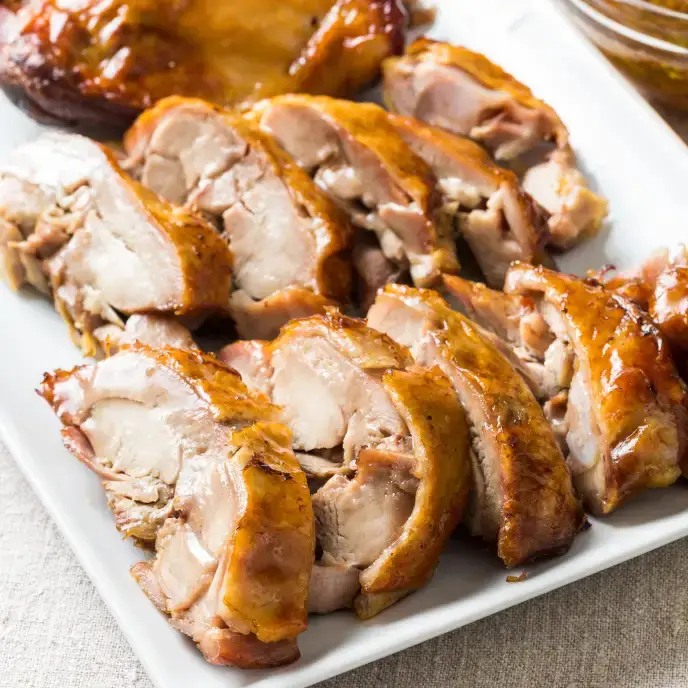
Turkey Thigh Confit with Citrus Mustard Sauce
Before refrigeration, confit was used as a simple and effective way to prolong the shelf life of foods, including duck or goose parts. The poultry was cured in salt and then gently poached in its own fat before being buried beneath the fat and stored in an airtight crock. At serving time, all that was needed was a blast of heat to crisp the skin. Today, all types of dark-meat poultry, pork, and game are given the treatment (tender white meat breaks down too much with this method), though regardless of the protein, duck fat is the traditional choice for the poaching step. For silky, supple, evenly seasoned, full-flavored turkey confit, we started by processing onion, salt, pepper, sugar, and thyme in a food processor. Next, we coated the turkey thighs in this paste and let them cure for at least four days. As the thighs sat, the salt, sugar, and some water-soluble compounds in the aromatics gave the turkey a deeply savory flavor. We rinsed away the cure and oven-poached the thighs in duck fat until they were tender. The thighs could then be refrigerated for up to six days or immediately browned and served with our bright and tangy citrus-mustard sauce.
Servings: 6
Ingredients
- 3 large onions chopped coarse (4¾ cups)
- 12 sprigs fresh thyme
- 2½ tablespoons table salt for curing
- 4 ½ teaspoons sugar
- 1 ½ teaspoons pepper
- 4 pounds bone-in turkey thighs
- 6 cups duck fat or use chicken fat, or vegetable oil, for confit
- 1 garlic head halved crosswise
- 2 bay leaves
- ½ cup orange marmalade
- 2 tablespoons whole-grain mustard
- ¾ teaspoon grated lime zest plus 2 tablespoons juice
- ¼ teaspoon table salt
- ⅛ teaspoon cayenne pepper
Instructions
Cure the turkey thighs:
- Process onions, thyme sprigs, 2½ tablespoons salt, sugar, and pepper in food processor until finely chopped, about 20 seconds, scraping down sides of bowl as needed.
- Spread one-third of mixture evenly in bottom of 13 by 9-inch baking dish.
- Arrange turkey thighs, skin side up, in single layer in dish.
- Spread remaining onion mixture evenly over thighs. Wrap dish tightly with plastic wrap and refrigerate for 4 to 6 days (whatever is most convenient).
Poach the turkey thighs:
- Adjust oven rack to lower-middle position and heat oven to 200 degrees.
- Remove thighs from onion mixture and rinse well (if you don't have a garbage disposal, do not allow onion pieces to go down drain).
- Pat thighs dry with paper towels.
- Heat the fat in a large Dutch oven over medium heat to 165 degrees.
- Off heat, add the turkey thighs, skin side down and in a single layer, making sure thighs are completely submerged.
- Add garlic and bay leaves.
- Transfer to the oven, uncovered, and cook until a metal skewer inserted straight down into thickest part of the largest thigh can be easily removed without lifting the thigh, 4 to 5 hours. (To ensure that oven temperature remains steady, wait at least 20 minutes before retesting if turkey is not done.)
- Remove from oven.
To make ahead:
- Let the turkey cool completely in the pot, for about 2 hours; cover the pot; and refrigerate for up to 6 days.
- Uncover the pot.
- Heat the pot over medium-low heat until the fat is melted, about 25 minutes.
- Increase the heat to medium, maintaining a bare simmer, and continue to cook until thickest part of largest thigh registers 135 to 140 degrees, about 30 minutes longer. (If turkey has been cooked in vegetable oil, heat pot over medium heat, maintaining bare simmer, until thickest part of largest thigh registers 135 to 140 degrees, about 30 minutes.)
Prepare the thighs for browning:
- Adjust the oven rack to the lower-middle position and heat the oven to 500 degrees.
- While the oven heats, crumple a 20-inch length of aluminum foil into a loose ball.
- Uncrumple the foil, place it in a rimmed baking sheet, and top with a wire rack.
- Using tongs, gently transfer the thighs, skin side up, to the prepared wire rack, being careful not to tear the delicate skin. Set aside.
Separate the fat and stock:
- Strain the liquid through a fine-mesh strainer into a large bowl.
- Working in batches, pour the liquid into a fat separator, letting the liquid settle for 5 minutes before separating the fat from the turkey stock.
Make the sauce:
- Transfer 4 teaspoons of the turkey stock to a small bowl.
- Add the marmalade to the bowl and microwave until the mixture is fluid, about 30 seconds.
- Stir in the mustard, lime zest and juice, salt, and cayenne.
- Transfer to a serving bowl.
Brown the thighs:
- Transfer the thighs to the oven and roast until well browned, 12 to 15 minutes.
- Transfer the thighs to a cutting board, skin side up, and let rest until just cool enough to handle, about 15 minutes.
De-bone and serve:
- Flip 1 thigh skin side down.
- Using the tip of a paring knife, cut along the sides of the thighbone, exposing the bone.
- Carefully remove the bone and any stray bits of cartilage.
- Flip the thigh skin side up.
- Using a sharp chef's knife, slice the thigh crosswise into ¾ inch thick pieces.
- Transfer to a serving platter, skin side up.
- Repeat with the remaining thighs.
- Serve, passing sauce separately.
Notes
- Start this recipe at least five days or up to 12 days before serving (almost all the time is hands-off).
- The proper measurement of salt is crucial here. Be sure to use table salt, not kosher salt, and to measure it carefully.
- To ensure proper seasoning, make sure that the total weight of the turkey is within 2 ounces of the 4-pound target weight; do not use enhanced or kosher turkey thighs.
- Though duck fat is traditional, we found that chicken fat or even vegetable oil will work nicely. Reserve the duck fat or chicken fat and remaining stock in step 5 for further use; used vegetable oil should be discarded.
- It is convenient to split up the cooking over several days, but if you prefer to do all the cooking in one day, go straight from step 2 (poaching) to step 5 (browning) without letting the turkey cool.