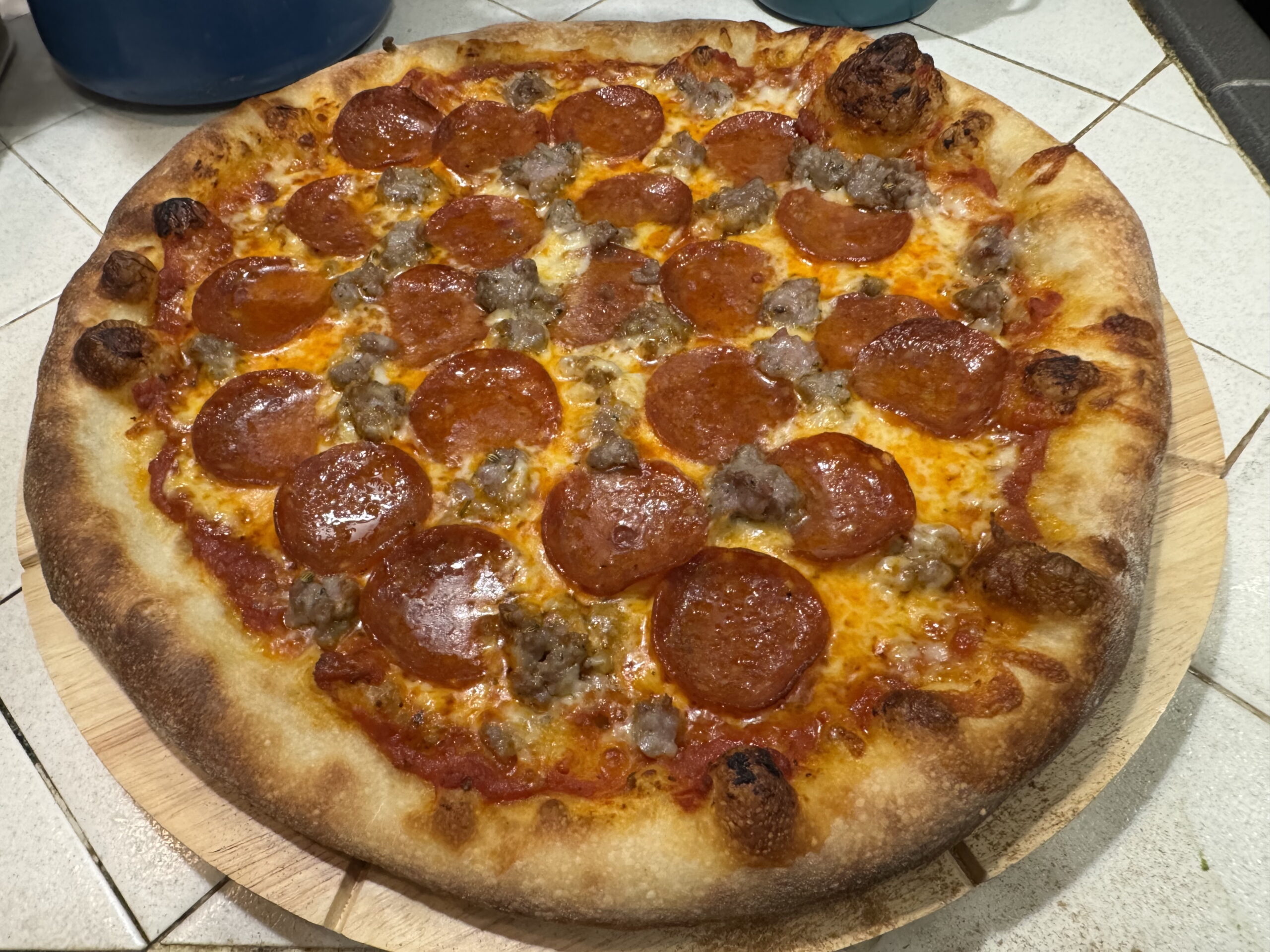
Tony Gemignani's Classic American Pepperoni Pizza
This Classic American Pepperoni and Sausage Pizza is based on a great multipurpose Master Dough that gives you a medium-thick, crispy-chewy crust.
Servings: 1 13-inch pizza
Ingredients
Dusting mixture:
- 75 grams flour whichever flour you used to make the dough
- 75 grams semolina
“MAKE LINE” INGREDIENTS FOR PEPPERONI (OR SAUSAGE) PIZZA:
- 1 370-gram ball Master Dough with starter 13-ounce
- 120 grams New York–New Jersey Tomato Sauce at room temperature, ½ cup
- 170 grams whole-milk mozzarella cheese shredded (6 ounces / 1½ cups), or 225 grams (8 ounces / 2 cups) if you are making a plain cheese pizza.
- 115 grams sliced pepperoni (4 ounces), or (140 grams / 5 ounces) uncooked bulk fennel or Calabrese sausage, or store-bought
“FINISH LINE” INGREDIENTS FOR PEPPERONI (OR SAUSAGE) PIZZA:
- garlic oil
- grated Pecorino Romano cheese
- dried oregano
Instructions
Bring the dough to room temperature:
- Remove the dough ball from the refrigerator and leave wrapped at room temperature until the dough warms to 60°F to 65°F. After the dough has sat on the counter, still covered, for an hour, poke an instant-read thermometer directly through the plastic wrap into the center of one of the dough balls. Keep checking until your dough is between 60°F and 65°F.
Setup the oven:
- Meanwhile, adjust your oven racks so that one is in the upper third (usually two rungs down) and one is on the bottom rung.
- Center a pizza stone or baking steel on each rack.
- Preheat the oven to 500°F for at least 1 hour. If you have a convection setting, use it. The temperature should still be 500°F but you’ll need to keep a watchful eye on your pizza because it will bake more quickly. (In our oven we use the convection setting, but keep the temperature at 500°F. Even though our oven can go to 550°F, we found that the crust darkens too quickly at that temperature).
Setup your work stations:
- Before you start working your dough, you’ll want to set out your topping and finishing ingredients, so you’ll be all ready to go when the time comes. In the biz, we call the toppings station the “make line,” as opposed to the “finish line” where baked pizzas get sliced and topped with any uncooked ingredients and garnishes.
Make line:
- Combine the pizza flour and semolina together in a small bowl and set to the side of the surface where you will be shaping your dough. This will be your dusting mixture used to shape your pizza and to dust your peel.
- Set your pizza peel next to your work surface.
Finish line:
- Set out a cutting board that is larger than 13 inches and a rocking pizza cutter or pizza wheel.
- If you have a nice wooden board, you can serve the pizza directly from it. If not, set out a couple flat, round platters for serving. Oversized flat chargers or pizza plates work well.
- Set out your finishing ingredients next to the cutting board.
Transfer the dough to the work surface:
- Your dough balls should now be disks, about 25 percent larger in diameter than when you first made them. If you see any air bubbles, pinch them to deflate them.
- Grab a“ generous handful of your dusting mixture and dust your countertop liberally. (You can’t really err on the side of overdusting; what you don’t need won’t stick.)
- Lift the edge of the plastic wrap and slowly peel it away from the dough disks. The more you practice this, the better you’ll get at peeling away the plastic without much of the dough sticking to it. Use your fingertips to gently coax any sticky dough off the plastic.
- Now you’re ready to move the dough to the counter. This is an important step. The idea is to get your disk of dough onto the counter as gently as possible, keeping it as close as possible to its shape on the sheet pan. You don’t want the edges to fold under, and you absolutely don’t want to punch down the dough or squish it back into a ball. Your job is to maintain the shape, airiness, and uniform thickness of that soft, nicely risen disk as you move it to the counter for stretching. If you do that, you’ll have a huge head start on stretching and shaping it into a perfect round of even thickness and circumference.
- Wet your dough cutter with a few drops of water to help keep it from sticking to the dough.
- If you have more than one dough disk on your sheet pan and the disks are touching at all, use the dough cutter to separate them, slicing straight downward between them (and between the dough and the rim of the pan, if they’re touching).
- Holding the dough cutter almost parallel to the sheet pan, gently scrape under the sides of the dough in short movements toward the center to release the disk from the pan, lifting the loosened dough a bit with your other hand.
- As you work, be careful to keep the dough in a flat circle, and try not to let the edges droop under the disk.
- Once the dough is completely unstuck from the pan, lift the disk carefully with the dough cutter and your free hand and flip it as gently as you can onto the flour-dusted counter.
- Dust the dough with a handful of the dusting mixture, then gently flip it back over so that it is right side up again, as it was when it was on the sheet pan. You will now have a nice, neat circle of dough that’s easy to work with and won’t stick to the counter or your hands.
Shape the pizza:
- Dust your peel with some of the dusting mixture and set the peel aside.
- Open the dough on the work surface to a 13-inch round with a slightly raised edge.
- Move the dough to the peel. As you work, shake the peel forward and backward to ensure the dough isn’t sticking.
Top the pizza:
- Grab a large kitchen spoon and spoon the sauce onto the center of the dough.
- Use the back of the spoon to spread the sauce outward from the center in a spiral, being careful to leave a uniform border of about ¾ inch all the way around the edge, coming just slightly up the rim 2. This, by the way, is what’s known as your sauce line. Try to keep it nice and neat, so your pizza has a finished look without stray splashes of burned sauce around the edge.
- Give the peel a shake to make sure the dough isn’t sticking, and then pour 6 ounces (170 grams/1½ cups) shredded mozzarella onto the center of the pizza.
- Use your fingertips to spread it out from the center so the sauce is evenly covered with cheese. Go all the way out to your sauce line but not over it. I like to push cheese out from the center this way, leaving a little less in the center, because the cheese tends to melt back into the middle as the pizza bakes.
- Now arrange the pepperoni slices evenly over the cheese.
- If you’ve decided to top your pizza with sausage rather than pepperoni, pinch flat, nickel-size pieces of the sausage and distribute them evenly over the cheese. If you’d rather make a plain cheese pie, use 8 ounces (225 grams/ 2 cups) mozzarella instead of 6 ounces (170 grams).
Bake the pizza and serve:
- Slide the pizza onto the top stone (see Moving the Dough to the Oven).
- Bake for 6 minutes. (3 minutes in our oven on convection)
- Lift the pizza onto the peel, rotate it 180 degrees, and then transfer it to the bottom stone.
- Bake for another 6 minutes, until the bottom is browned and crisp and the top is golden brown. (3 minutes in our oven on convection)
- Transfer the pizza to a cutting board and cut into 6 wedges.
- Use a pastry brush to drizzle the pizza with garlic oil, then sprinkle the Pecorino Romano and oregano on top.
- Transfer your pizza to a platter (or leave it on the board) and call in your hungry eaters.