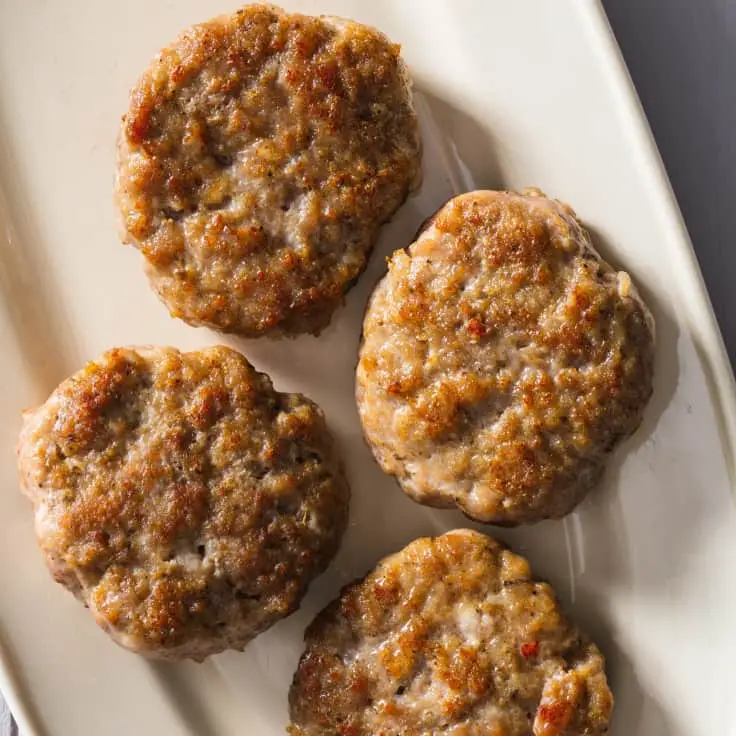
Breakfast Sausage Patties
Turning a tough cut of pork into snappy, succulent sausage is easier than you'd think, and having a batch on hand can be any cook's secret weapon. Fresh bulk sausage is nothing more than salted and seasoned meat that you grind and vigorously mix, and making a good batch is simple if you adhere to a few principles and use a reliable formula. Once made, the sausage could be formed into patties and cooked straight away or refrigerated or frozen for later use.
Servings: 16 patties
Ingredients
- 1 tablespoon packed light brown sugar
- 2 teaspoons rubbed sage
- 1 teaspoon pepper
- ¼ teaspoon cayenne pepper
- 2 pounds boneless pork butt roast with at least ¼-inch-thick fat cap
- salt
- 2 teaspoons vegetable oil
Instructions
Cure the pork:
- Mix the sugar, sage, pepper, and cayenne in a small bowl and set aside.
- Leaving the fat cap intact, cut the pork into ¾-inch pieces, trimming and discarding all sinew and connective tissue.
- Weigh the trimmed pork and note the weight in grams.
- Multiply the weight of the pork by 0.015 to determine the salt amount (round to nearest gram).
- Weigh out the salt.
- Toss the pork, salt, and sugar mixture in a bowl until well combined.
- Cover and refrigerate for at least 8 hours or up to 2 days.
Freeze and grind the pork:
- Transfer the pork to rimmed baking sheet and spread in a single layer, leaving space around each chunk.
- Freeze until the pork is very firm and starting to harden around edges but still pliable, 35 to 55 minutes.
FOR A GRINDER:
- Place the meat grinder attachments, including the coarse die (3/16 or ¼ inch), in the freezer for at least 1 hour before using.
- Set a medium bowl in a large bowl filled with ice.
- Grind the pork at medium speed into the prepared medium bowl.
FOR A FOOD PROCESSOR:
- Place one-quarter of the pork in the food processor and pulse until finely ground into ⅛- to 1/16-inch pieces, 14 to 16 pulses, stopping to redistribute pork around bowl as necessary to ensure meat is evenly ground.
- Transfer the ground pork to a large bowl.
- Repeat with the remaining 3 batches of pork.
Shape the patties:
- Inspect the ground pork carefully, discarding any strands of gristle or silverskin.
- Using your hands or a stiff rubber spatula, knead the pork vigorously, smearing it against the sides and bottom of the bowl, until the pork begins to tighten, feels tacky, and sticks to the bottom of the bowl and the palm of your hand, 1½ to 2 minutes.
- Using your damp hands, divide the meat into 16 pieces (about 2 ounces each) and form into 2½-inch patties about ½ inch thick.
Cook and serve:
- Heat the oil in a 12-inch nonstick skillet over medium heat.
- Cook half of the patties until well browned on both sides and the meat registers 145 to 150 degrees, 3 to 5 minutes per side.
- Transfer to a serving platter and tent with aluminum foil.
- Repeat with remaining patties. Serve.
Notes
- Because sausage requires a precise ratio of salt to trimmed meat, you'll need a scale that measures in grams, and you'll need to do some simple math. This recipe requires at least 8 hours of salting. Because you'll be measuring the salt by weight instead of volume, you can use either table salt or kosher salt.
- Pork butt roast is often labeled Boston butt. For the best texture, buy a well-marbled roast that has a defined fat cap.
- This recipe can easily be halved or doubled and freezes well.
TO MAKE AHEAD:
- Raw sausage patties can be refrigerated, covered, for up to 24 hours or frozen for up to 1 month.
- Cook frozen patties for 7 to 9 minutes per side.